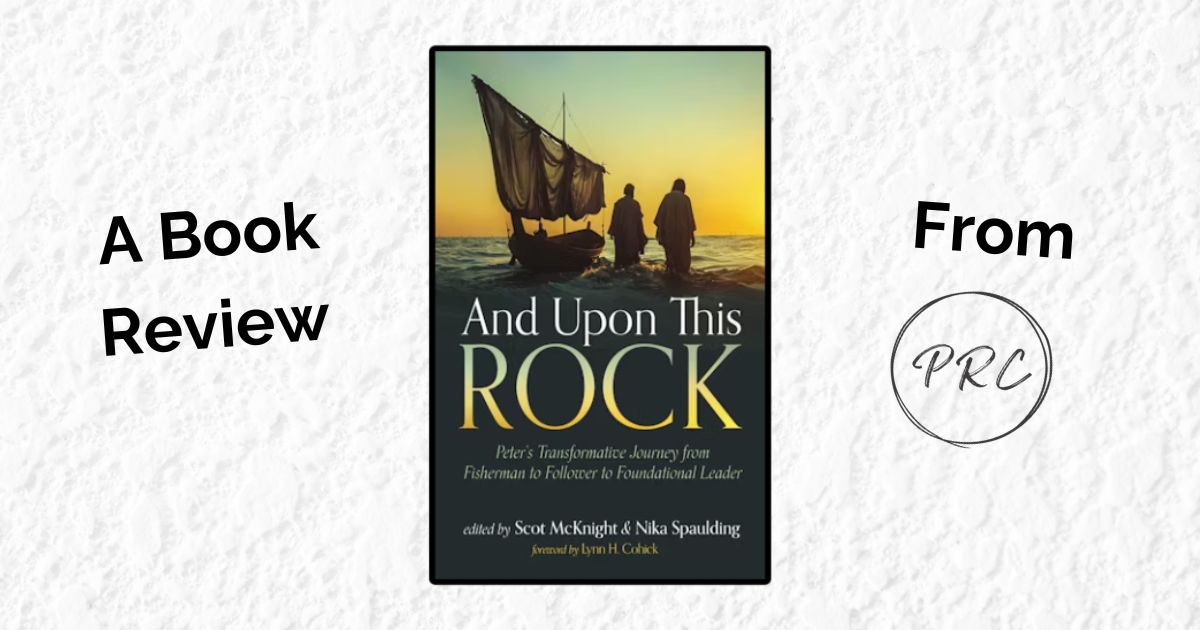

Because And Upon This Rock is a collection of essays rather than the work of a single author, it is brimming with ideas—all centered on the disciple Peter. The sixteen essays were mostly written by Doctor of Ministry students, but while they tend to be academic, they remain accessible to general readers. Many take a pastoral perspective. Each essay includes plentiful footnotes and an extensive bibliography. In addition to the essays, the book concludes with an address given by one of the editors on the occasion of an ordination.
Lynn H. Cohick, a professor at Houston Christian University, where the doctoral students studied, notes in the foreword that he was unprepared for the experience he had reading the essays. He writes that although he’s more of a “Paul” fan than a “Peter” enthusiast, “…I was unprepared to like Peter as much as I did.”
The essays sometimes take a broad view of Peter’s ministry and sometimes focus on a single story or theme. Some engage one or more gospel passages, others explore the Peter of Acts, and still others reflect on the two pastoral letters attributed to him. Together, they move the reader beyond the typical image of Peter as impulsive, emotional, and immature. Each essayist writes from a distinctive perspective. Brenton S. Fessler, a Pentecostal pastor, titles his essay “Peter the Pentecostal Pastor” and notes that Pentecostal preachers see Acts 2—where Peter explains that the speaking in tongues and miraculous events are signs of the Holy Spirit being poured out—as a foundational text for Pentecostal faith and practice.
The overall viewpoint is theologically conservative, which is not surprising given that Wipf and Stock, the publisher (which provided a copy of the book for this review) openly holds a conservative theology; the book is published under their Cascade Books imprint. Houston Christian University is also largely conservative. One example of this is that several essayists accept without question that the epistles attributed to Peter were written by the apostle himself.
You might enjoy all the essays in this book—or none—but most readers will probably have a few favorites. You might even skim or skip a few. Two of my own favorites were the opening essay, “In the Deep with Peter and Jesus,” and the penultimate one, “Feed My Sheep.”
“In the Deep with Peter and Jesus,” by Noah Schumacher, describes the writer’s struggle with depression and a sense of failure as his church faces disunity and chaos. Crying out to God for help, he finds himself identifying with Peter, who also felt like a failure but was forgiven by Jesus. The essay centers on three events in Peter’s life—his calling by Jesus, his testing on the water, and his restoration in John 21. After reflecting on these moments, Schumacher concludes that “…each of us can be restored to the proper place Jesus has for us.”
Matthew Trexler’s “Feed My Sheep,” subtitled “Failing Forward in Ministry – A Pastoral Reflection,” argues that even the most painful failures can be turned by Jesus into vehicles of blessing. As Jesus did for Peter, he recalls failing and errant disciples to their mission and kingdom work—this is what we call grace. The essay’s closing paragraph is worth quoting in full:
We are to care for the people that Jesus brings into our churches and into our lives. This is Jesus’s great ordination charge. He is only willing to entrust it to disciples who are most qualified for this high calling—the poor in spirit who fail and feel their failure but have also felt the forgiving embrace of God. May he give us his grace and power in this incredible and awesome undertaking.