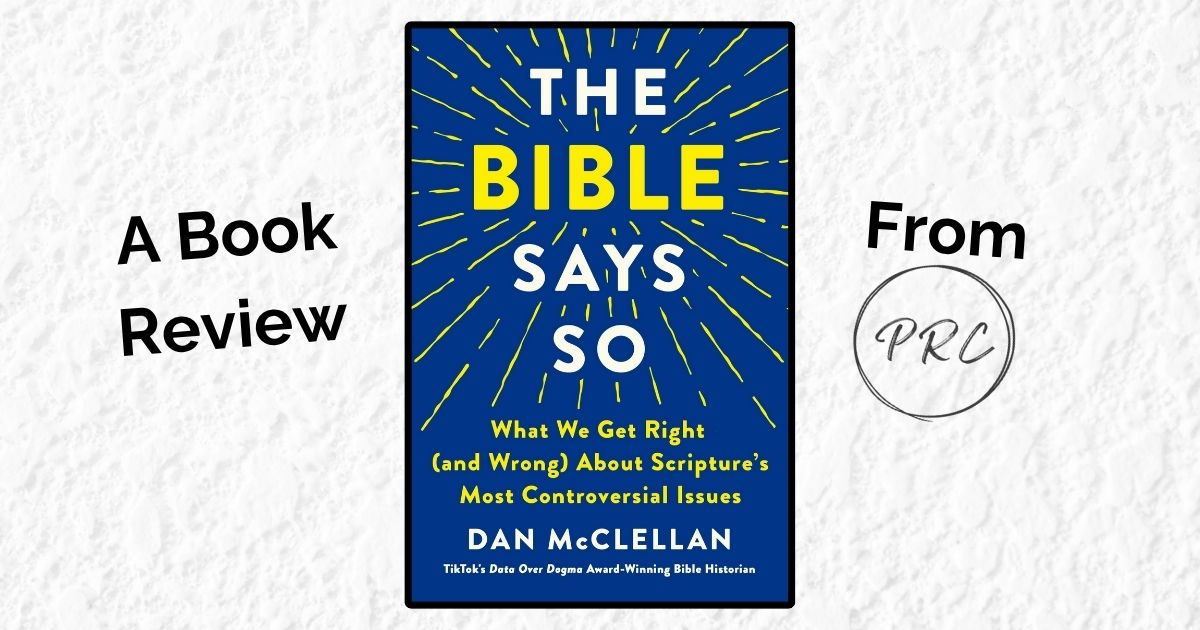

If you’re content viewing the Bible as one cohesive narrative and prefer straightforward interpretations, then The Bible Says So: What We Get Right (and Wrong) About Scripture’s Most Controversial Issues may not be for you. If, on the other hand, you enjoy focusing on the meaning of Bible passages by examining original languages, cultural contexts, and exploring how it was created, transmitted, and received over time, this book will no doubt interest you.
Author Dan McClellan is not only a highly educated and well-credentialed Biblical scholar but also has an active presence on social media, where he discusses academic approaches to Scripture. He cohosts the Data Over Dogma podcast and is active on TikTok, Instagram, and other platforms. The Bible Says So is published by St. Martin’s Press, a subsidiary of Macmillan Publishers, which publishes a wide range of books.
The Introduction is one of the most engaging sections of the book. McClellan explains that his career is dedicated to “better understanding the Bible’s history, significance, and meaning” by interpreting it on its own terms — as its original authors, editors, and earliest audiences would have. He refers to his approach to the Bible as historical-critical, using critical methodologies to understand what people at certain points in history probably understood it to be.
McClellan also strives to put “data over dogma,” meaning he prioritizes evidence over preconceived beliefs — his own and those of others. He contends that in one sense, the Bible doesn’t say anything at all; it’s a collection of texts that do not have inherent meaning. He states that he’s trying (most of the time) to represent the academic consensus — the positions shared by the majority of biblical scholars.
Chapter One was thought-provoking. McClellan discusses how the Bible came to be and concludes that it would be simplistic to say it has 45 authors; its creation was more complicated than that. He also points out that the various religious groups who consider the Bible to be their “holy” book, don’t actually share the same version of the Bible.
The topics covered in the book ranged from those of interest to a wide range of readers, such as abortion and homosexuality, to some esoteric ones, such as whether God has a wife or whether God has a body. If you find these last two topics surprising, their inclusion by the author makes sense when you realize he is a member of the Church of Jesus Christ of Latter-day Saints, which teaches that God has a wife and a body. So, if how Mormons justify these beliefs using the Bible interests you, you’ll want to give those chapters a read.
McClellan makes an important point in the Conclusion of the book related to how we interpret the Bible today. He emphasizes that it’s not one voice with straightforward answers, but a collection of writings produced over a long period of time and influenced by the historical, cultural, and religious ideas of various eras. We need to acknowledge its complexity, realizing it reflects evolving ideas about God and people, so that we can move beyond an oversimplified “the Bible says so” argument. Indeed, I’m sure that some of McClellan’s conclusions are refuted by other biblical scholars. Humility is needed when making claims about what the Bible “says.” It reminds me of a Peanuts comic where Snoopy is writing a book on theology titled, “Did It Ever Occur to You That You Might Be Wrong?”

0 Comments